
Our history
Covering the Ohio Statehouse since 1893
Jump to: How OLCA began · Key Moments in OLCA History · Reporters of note
The Founding
How OLCA began
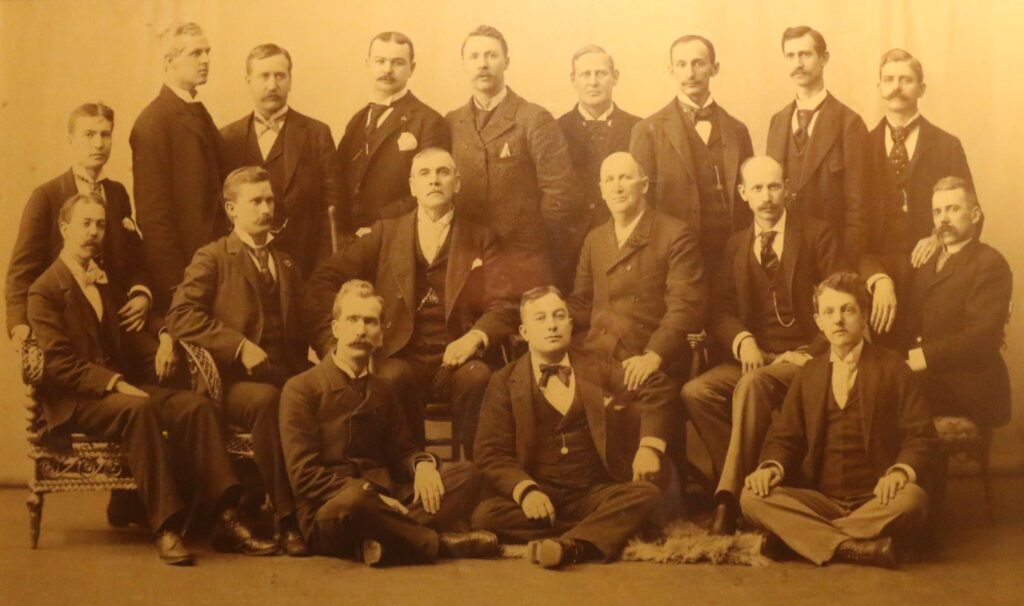
It was 1890, and James W. Faulkner was astonished.
The 27-year-old had just arrived in Columbus to begin his tenure as Statehouse correspondent for the Cincinnati Enquirer.
Inside the Statehouse, he found “a Legislature and Statehouse staff cowed by lobbyists for special interest groups — lobbyists who invaded the chambers of the Legislature, buttonholing lawmakers in sessions,” as the Enquirer recalled in a March 20, 1966, retrospective.
OLCA member and longtime Ohio State Journal editor Jacob A. Meckstroth, who documented OLCA’s history in the 1960s, also described the presence of “hack writers who added to the confusion” in those early days.
“(The hacks) posed as correspondents, and offered at little or no cost a pseudo-legislative ‘newsletter’ to newspapers (without a) Columbus correspondent,” Meckstroth wrote. ” These letters would contain enough real news to appear genuine but slyly woven into them would be the propaganda of the real but hidden employer of the counterfeit correspondent.”
Faulkner and his fellow correspondents mobilized into what became the Ohio Legislative Correspondents Association. Members quickly elected Faulkner the group’s president — a post he would hold until 1915.
He and fellow members proposed to legislative leaders that they bar all but bona fide journalists from legislative sessions. In 1893, legislative leaders agreed, delegating to OLCA the authority to accredit journalists for access to the House and Senate floor, a responsibility that continues today.
Who’s pictured ABOVE
Back row (left to right): K.E. Landon, Cincinnati Enquirer; J.H. Galbraith, Pittsburgh Post; C.N. Gaumer, Mansfield Shield & Banner; J.W. Faulkner, Cincinnati Enquirer; G.H. Gordon, Toledo Blade; C.N. Vallandigham, Cincinnati Post; J.W. Flickinger, Ohio State Journal; Hartzell Caldwell, Cincinnati Tribune. Seated: C.M. Stadden, Cleveland Leader / Toledo Commercial; J.W. Strimple, Columbus Press-Post; Hal D. Landon, press representative for Ohio at the World’s Fair; J.B.K. Connelly, Toledo Blade; Malcolm Jennings, Cincinnati Commercial-Gazette; W.A. Taylor, Cincinnati Enquirer; E.W. Doty, Cleveland World; Harry Miner, Cincinnati Times-Star; L.P. Stephens, Cleveland Plain Dealer / Columbus Dispatch.
Timeline
Key moments in OLCA’s history
1890
James W. Faulkner arrives in Columbus as the Statehouse correspondent for the Cincinnati Enquirer.
Early 1890s
Faulkner and fellow Statehouse reporters organize the group that becomes the Ohio Legislative Correspondents Association. Colleagues elect him its first president.
1893
Legislative leaders authorize OLCA to vet news reporters for floor access, a role the association still carries out today. That same year, Rep. Edward W. Doty, himself an OLCA member, introduces a resolution to allot the press use of a room “on the third floor of the capitol building,” possibly securing journalists their first Statehouse Press Room.
1923
Faulkner, who served as OLCA president until 1915, dies while attending a conference in New York.
Mid-1940s
Audrey Dillman, a Statehouse reporter for United Press, becomes the first woman admitted to OLCA. She later becomes a pioneer in Washington television news.
1952
OLCA agrees to a proposal by the House Clerk to relocate the Press Room to its current location on the Statehouse’s north side, allowing the clerk to move his office to the press’s old quarter on the third floor. The primary selling point: The new OLCA space has air conditioning.
1973
OLCA members fashion a proposed code of ethics and financial disclosure requirements for members. The idea is defeated in a deadlock vote, with opposition partly attributed to concerns adoption would make it appear OLCA was lobbying in support of a pending legislative ethics bill in the Ohio House.
1983
Mary Anne Sharkey of The Plain Dealer becomes the first woman elected OLCA president.
Today
Nearly 50 members report for print, radio, television and digital news.
Sources: Cincinnati Enquirer, July 28, 1923, p. 4; United Press International, June 17, 1984; Harvard Kennedy School Institute of Politics, Mary Anne Sharkey; Columbus Foundation, James W. Faulkner Memorial Fund; “Legislative Reporting at the Ohio Statehouse and on the History of the Ohio Legislative Correspondents Association,” compiled by Thomas Suddes, Sept. 16, 1990 (OLCA records).
People
Statehouse reporters of note
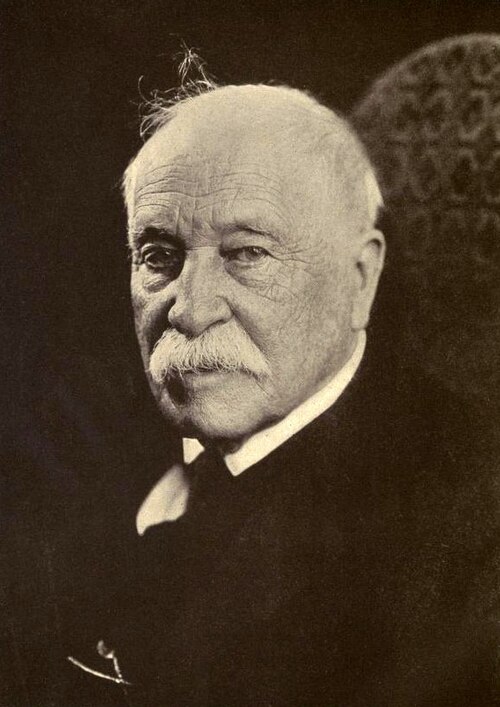
William Dean Howells
1837–1920 · Novelist, critic and editor
Howells joined the Ohio State Journal in Columbus in 1858, writing poems, stories and reviews and translating foreign news. He also wrote a “Letter from Columbus” column for the Cincinnati Gazette, signed “Jeffersonian.” He went on to become one of the country’s leading novelists and critics, known as the “Dean of American Letters.”
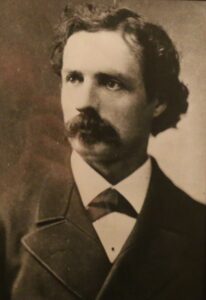
Whitelaw Reid
1837–1912 · Newspaper correspondent and editor
Reid began as editor of a weekly paper in Xenia. In 1861 he reported on the Statehouse and the 54th General Assembly for three newspapers, then became a Civil War correspondent and the author of “Ohio in the War.” He later succeeded Horace Greeley as editor and publisher of the New York Tribune. A plaque honoring him hangs in the Statehouse Press Room.
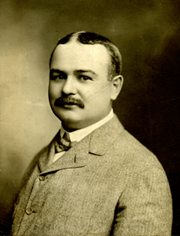
James W. Faulkner
1863–1923 · Cincinnati Enquirer correspondent
Called the “dean of Ohio newswriters” at his death, Faulkner arrived in Columbus in 1890 to cover the General Assembly for the Enquirer. He helped organize the Statehouse press corps into the Ohio Legislative Correspondents Association and served as OLCA’s first president until 1915.
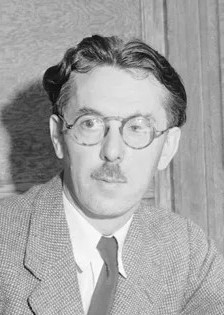
James Thurber
1894–1961 · Columbus Dispatch reporter
Writer, humorist and cartoonist James Thurber was an OLCA member during his years at The Columbus Dispatch in the early 1920s, a job he called “the highest ambition of my boyhood” in a 1951 article for The New Yorker. “My youthful ambition to join the ranks of the great men in the State House pressroom has long since dwindled to rational proportions, but I still have my membership card, after more than a quarter of a century,” he wrote.
Header image: Two boys selling newspapers in front of the Ohio Statehouse, ca. 1930, courtesy of the Ohio History Connection. Other images: 1893 OLCA image from OLCA records; Howells, Whitelaw and Faulkner images are in the public domain. Thurber image courtesy of The Columbus Dispatch.